





SEMINAR SERIES

PacVec holds monthly seminars that convenes public health and vector control professionals, and features the work of PacVec’s principal investigators, trainees, and visiting researchers that are relevant to the center’s mission. Seminars are held monthly during the academic year from October through June and are available via Zoom. To be notified about upcoming seminars, please sign up for our mailing list by clicking subscribe.

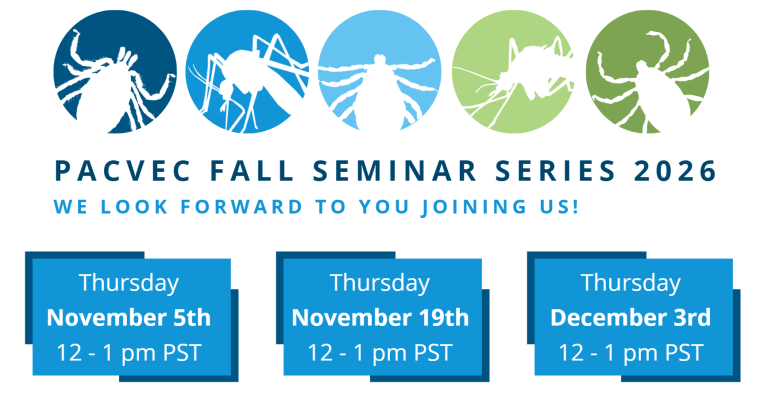
We’re excited to announce the dates for the 2026 PacVec Fall Seminar Series! Join us for three virtual sessions highlighting the work of PacVec trainees and researchers. Speakers and presentation details are detailed below!

Thursday, November 5th, 12 - 1 pm PST

“Applied Learning in Medical and Veterinary Entomology”

“Degrees of Resistance: How Temperature Shapes Transcriptional Responses to Pyrethroids in Aedes aegypti“

Kelsey Lyberger
Arizona State University

Kelsey Lyberger is an Assistant Professor in the School of Applied Sciences and Arts at Arizona State University. She received her PhD in Population Biology from UC Davis, and completed an NSF postdoctoral fellowship at Stanford. Her research examines how environmental variation and species interactions shape ecological and infectious disease dynamics, with a particular focus on mosquitoes and vector-borne disease. In her teaching, she is interested in incorporating applied, real-world problems that connect ecological concepts with public health practice.

Matt Hernandez
University of Tulsa

Matt Hernandez is a Ph.D. student in Biological Science at the University of Tulsa whose research examines how environmental factors influence the underlying physiological mechanisms of insecticide resistance in mosquitoes. His master’s research at California State University, Fresno, investigated temperature-dependent responses to the pyrethroid λ-cyhalothrin in Aedes aegypti using bioassays and transcriptomics. His current work explores the role of septate junction (SJ) proteins, which regulate the permeability and functions of intestinal and renal epithelia, and how they contribute to the increasing resistance to insecticides. He also brings experience in applied vector control through his work with the Madera Mosquito and Vector Control District. 

Thursday, November 19th, 12 - 1 pm PST


“Engaging Local Stakeholders to Guide Vector-Borne Disease Education”

“Evaluating Health Promotion and Communication Strategies for Mosquito-Borne Disease Control in the United States: A Scoping Review”

Skyler Finucane
University of Arizona

Skyler Finucane is a third-year Epidemiology PhD student at the University of Arizona with a master’s degree in Entomology and Insect Science. Her background is in public health entomology, and her research applies a One Health approach to vector-borne disease education and outreach. Her current work focuses on tick-borne diseases in Arizona and bridging gaps between veterinary and public health professionals to strengthen disease surveillance and prevention.

Jordan Robinson
University of Arizona

Jordan is a first year PhD student in the epidemiology program at the University of Arizona. As a master’s student, she worked in Dr. Kacey Ernst’s PacVec lab on novel vector outreach and education and continues these projects in her doctoral studies. 

Thursday, December 3th, 12 - 1 pm PST

“A One Health Approach to Tick-borne Disease Hazard in Northern California: Integrating Human, Animal, and Environmental Perspectives with an Emphasis on Tribal Communities”


“Maintenance and Variant Circulation of St. Louis Encephalitis Virus in the American Southwest”

Patty Torres
University of Georgia 

Patty Torres is a PhD candidate in the Integrative Conservation (ICON) program at the University of Georgia Warnell School of Forestry and Natural Resources. Her research takes a One Health approach to tick-borne disease, connecting human, animal, and environmental perspectives through spatial epidemiology, disease ecology, and sentinel surveillance. Working with Tribal and community partners in Humboldt County, California, she combines field tick collection, pathogen testing, and GIS-based hazard mapping to show where people and their animals may face tick-borne disease risk. Her research also includes a study on tick-borne disease knowledge and behaviors among Native American communities in northern California, and a study of vector-borne pathogens in companion animals.

Brooke Schmidt 
Northern Arizona University

Brooke Schmidt is a Ph.D. student in Biology at Northern Arizona University under the mentorship of Dr. Crystal Hepp. She is also an employee of Arizona State University’s Health Observatory and an affiliate of the Translational Genomics Research Institute (TGen). Her research focuses on the ecology and evolution of mosquito-borne viruses, particularly St. Louis encephalitis virus (SLEV) and West Nile virus (WNV). Her current work investigates the genetic diversity and movement of SLEV across the southwestern United States to better understand its circulation and evolution within the region.

PAST SEMINARS & RECORDINGS

SUBSCRIBE

Subscribe to our weekly newsletters to be notified about upcoming seminars. All seminar announcements include a link to participate remotely via Zoom.

COLLABORATION

Our center is always looking to broaden and strengthen our community of practice. If you are interested in working with us, please contact us!

The Pacific Southwest Regional Center of Excellence in Vector-Borne Diseases is supported through Cooperative Agreement Number 1U01CK000649 between the Centers for Disease Control and Prevention (CDC) and the University of California, Davis.

© 2026 – All rights reserved